Official Bananagrams Rules: Tiles, Peel, Dump & How to Win
Bananagrams is a fast crossword race with no board and no turns. Everyone builds their own grid at the same time, and the first person to use up all their tiles in a valid grid wins. The rules fit on a card, but a handful of them (proper nouns, dumping, when exactly you win) trip people up. This is the full guide, with the official numbers, the official terms, and clear answers to the questions people actually argue about at the table.
The short version
- 144 tiles total, no board, 1 to 8 players.
- Draw your starting tiles (21 each for 2 to 4 players), flip them on "Split!", and build a connected crossword.
- Empty your hand, call "Peel!", and everyone draws one more tile.
- Stuck with a bad letter? Call "Dump!" to trade 1 tile for 3.
- When the bunch runs low, the first to finish a valid grid calls "Bananas!" and wins.
- No proper nouns, no abbreviations. Two-letter words and plurals are fine.

How many tiles do you start with? (by player count)
2 to 4 players draw 21 tiles each, 5 to 6 players draw 15, and 7 to 8 players draw 11. Bananagrams has 144 letter tiles total. The rest stay face-down in the bunch and get fed out one at a time during the game.
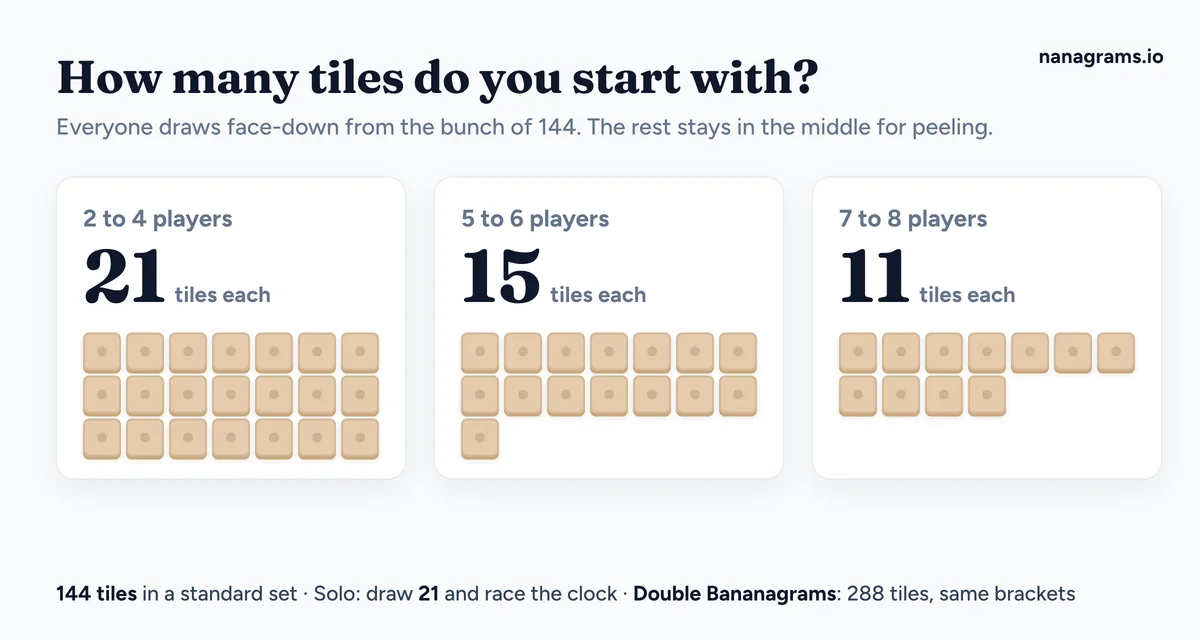
| Players | Starting tiles each | Total dealt at start | Left in the bunch |
|---|---|---|---|
| 1 (solo) | 21 | 21 | 123 |
| 2 to 4 | 21 | 42 to 84 | 102 to 60 |
| 5 to 6 | 15 | 75 to 90 | 69 to 54 |
| 7 to 8 | 11 | 77 to 88 | 67 to 56 |
So the common questions, answered directly:
- 2 players: 21 tiles each (42 dealt, 102 left in the bunch).
- 3 players: 21 tiles each (63 dealt, 81 left in the bunch).
- 4 players: 21 tiles each (84 dealt, 60 left in the bunch).
- 5 players: 15 tiles each (75 dealt, 69 left in the bunch).
- 6 players: 15 tiles each (90 dealt, 54 left in the bunch).
- 8 players: 11 tiles each (88 dealt, 56 left in the bunch).
The counts drop as the group grows so the bunch does not empty in the first thirty seconds. Fewer starting tiles means more peels, which keeps a big table in the game longer.
How many players can play Bananagrams?
One standard set handles 1 to 8 players. You can play solo as a puzzle against the clock, two-player head to head, or up to eight in a noisy group. Eight is the official maximum for a single 144-tile set. (For team formats, party brackets, and playing with 9+ people, see our full guide to how many people can play Bananagrams.)
Want more than eight? You have two options. Combine two regular sets, or pick up Double Bananagrams, the official 288-tile version built to scale up to 16 players — we cover its setup and tile counts in our Double Bananagrams rules guide. Online, the constraint is different: a digital set never runs out of tiles, so room sizes are set by the platform rather than by the box. Nanagrams rooms support up to 8 players, matching the physical game.
Bananagrams rules by player count
The rules never change with the head count. Only two things move: how many tiles each player draws at the Split, and how fast the bunch drains to the point where someone can call Bananas (which needs fewer tiles left than there are players). Here is how each table size actually plays.
1 player (solo Bananagrams)
Bananagrams works as a genuine solo game, not just a two-player game you practise alone. Draw 21 tiles, flip them, and build. Each time your hand is empty, peel one tile from the bunch and keep going until the bunch is gone and every one of the 144 tiles sits in a valid, connected grid. Time yourself. The usual goals are to beat your best time, to finish without a single dump, or to build the grid with the fewest words. Online, Nanagrams runs the same solo mode with automatic word checking, and you can add a bot if you want something to race.
2 players
Each player draws 21 tiles, leaving 102 in the bunch. Two-player Bananagrams is the longest version of the game because the bunch drains slowly: every peel takes only two tiles. Bananas can be called once the bunch is down to a single tile. If one player is much faster, level it with a house rule rather than a handicap on tiles, for example a three-letter minimum for the stronger player.
3 to 4 players
Still 21 tiles each: 63 or 84 dealt, 81 or 60 left in the bunch. This is the sweet spot the game was designed around. Peels come fast, a dump genuinely hurts, and the endgame arrives after roughly ten to fifteen minutes. Bananas becomes callable once the bunch has fewer than three (or four) tiles left.
5 to 6 players
Draw 15 each: 75 or 90 dealt, 69 or 54 left. Starting hands shrink so the bunch survives the opening rush. With six people every peel pulls six tiles out of the middle, so the endgame can arrive suddenly. Keep an eye on the pile.
7 to 8 players
Draw 11 each: 77 or 88 dealt, 67 or 56 left. Eight is the ceiling for one set. Table space becomes the real constraint, and a peel takes eight tiles at a time, so the bunch empties in a hurry. For bigger groups, see how many people can play Bananagrams for team formats, or move up to Double Bananagrams and its 288 tiles.
Official Bananagrams Rules (Standard Game)
What is in the box
- 144 letter tiles in the zip-up banana pouch.
- No board, no pen, no paper, no scorepad. Just tiles.
- 1 to 8 players. Two to four is the sweet spot, but it works fine all the way up.
Setup: the Split
- Dump every tile face-down in the middle of the table. That pile is the bunch.
- Each player draws their starting tiles and leaves them face-down (21 each for 2 to 4 players; see the table above for larger groups).
- When everyone is ready, one person calls "Split!" and all players flip their tiles at the same moment. There are no turns from here on. Everybody plays at once.
Building your grid
Once tiles are flipped, you build your own crossword. Place tiles next to each other to spell words that read left-to-right or top-to-bottom, the way a crossword does. The goal is to use every tile in your hand.

The grid rules in one place:
- Everyone builds their own grid. You are not adding to anyone else's.
- Every word has to connect, crossword-style. No floating words off on their own.
- Two-letter words count (QI, ZA, XU). Many groups raise the minimum to three letters for a harder game.
- Words read left-to-right and top-to-bottom only. No diagonals, no backwards.
- No proper nouns and no abbreviations (more on both below).
- Anything in a standard English dictionary is fair game, plurals included.
- Rearrange whenever you like, as much as you like. There is no penalty for tearing your grid apart and rebuilding it.
Peeling for more tiles
The instant your hand is empty and your grid is valid, call "Peel!" Then every player, including you, takes one tile from the bunch. Slot your new tile into your grid and keep going.
Peel is what keeps the pressure on. There is no reason to sit on an empty hand, and peeling forces everyone else to absorb a fresh tile whether they were ready for it or not. A fast player can bury slower opponents under a stack of unplaced letters this way.
Dumping a tile you hate
Stuck with a Q and no U, or a third V you cannot place? Call "Dump!", put that one tile back into the bunch face-down, and draw three in its place. There is no limit on how often you can dump.
The math is the catch: you trade one bad tile for three more tiles you now have to place. Dump too freely and your hand balloons while everyone else is peeling away. Use it when a single letter is genuinely jamming your whole grid, not just because you do not feel like dealing with a K.
Winning: calling Bananas
The endgame starts when the bunch has fewer tiles left than there are players, because at that point nobody can peel anymore (a peel needs one tile for everyone). From then on, the first person to use every tile in a valid, connected grid calls "Bananas!"
The other players then check the grid:
- Every word is real and spelled correctly.
- The whole grid connects, with no stray words floating off the side.
- The hand is genuinely empty.
Pass the check and you win. Fail it and you are a rotten banana: your tiles go back into the bunch, you are out, and the rest of the table plays on. It is worth a ten-second self-check before you shout. Calling Bananas on a grid with a typo in it is a classic way to hand the game to someone else.
Split, Peel, Dump, Bunch, Bananas: the official terms
Bananagrams has its own vocabulary, and the official rulebook uses these exact words. Here is the full glossary in one place.
| Term | What it means |
|---|---|
| Bunch | The pile of all 144 tiles, face-down in the center. Everyone draws from it. |
| Split | The start call. Everyone flips their tiles face-up at the same time and begins building. |
| Peel | Called when you place your last tile. Every player draws one new tile from the bunch. |
| Dump | Return one unwanted tile to the bunch and draw three in its place. No limit on uses. |
| Bananas | The win call. Used by the first player to finish a valid grid once the bunch is too low to peel. |
| Rotten banana | A failed Bananas call. The grid had an error, so that player is out and the others continue. |
If you play online, the calls become buttons. On Nanagrams, DRAW is the peel, SWAP is the dump, and GRAMS is your Bananas. More on the online differences further down.
What words are allowed in Bananagrams?
This is where most table arguments happen. The short rule: if a word is in a standard English dictionary, it is legal. The exclusions are narrow but strict.
Can you use proper nouns? No.
Proper nouns are not allowed. That rules out the names of people, places, brands, days of the week, and months. PARIS, NIKE, TUESDAY, and MARCH are all out as proper nouns.
The wrinkle that catches people: some of those words are also ordinary dictionary words. MARCH is a verb (to march). CHINA is a common noun (dishware). POLISH means to shine something. When a word has a legitimate lowercase meaning, you can play it for that meaning. You just cannot play it as the name.
Can you use names? Only if they double as real words.
A name on its own is a proper noun, so JOHN-the-person does not count. But plenty of names are also ordinary words: JOHN is a toilet, BILL is an invoice, FRANK is a hot dog, JOE is slang for coffee. Those play fine, because the dictionary lists them as common words. The name happening to exist is a coincidence, not the reason they are legal.
Are abbreviations allowed? No.
Abbreviations and acronyms are out. TV, USA, ASAP, and DIY do not count, even though everyone knows what they mean. They are shorthand for other words, not words themselves.
The exception is the small set of abbreviations that earned their way into the dictionary as standalone words. RADAR and LASER both started as acronyms and are now plain words, so they are legal. The test is always the same: is it a word the dictionary defines on its own?
What about slang, plurals, and verb forms?
- Plurals: Yes. CATS, BOXES, and MICE are all fine.
- Verb conjugations: Yes. RAN, RUNS, and RUNNING are all valid (a made-up form like RANNED is not).
- Slang: Allowed if your dictionary lists it. Modern Scrabble dictionaries include a lot of slang (ZA, OK, BAE), so agree on the dictionary before you start.
- Foreign words: Only if they have been adopted into English and appear in an English dictionary (TACO, KAYAK).
Can you repeat words (use the same word twice)? Yes.
Yes — you can repeat words in Bananagrams. There is no rule against using the same word more than once in your own grid, and with short connectors you will do it constantly: AT three times, IT twice, whatever keeps everything linked. Different players can also use the same word independently, since each grid is its own thing. Repeats are normal, not cheating.
The letter distribution: what is in the 144 tiles
A standard set has 144 tiles and no blanks. Knowing the mix tells you what to expect from the bunch. Vowels are 60 of the 144 (A 13, E 18, I 12, O 11, U 6), and there are only two each of J, K, Q, X and Z, so one of those in your hand is a problem to solve now, not a tile to wait out.
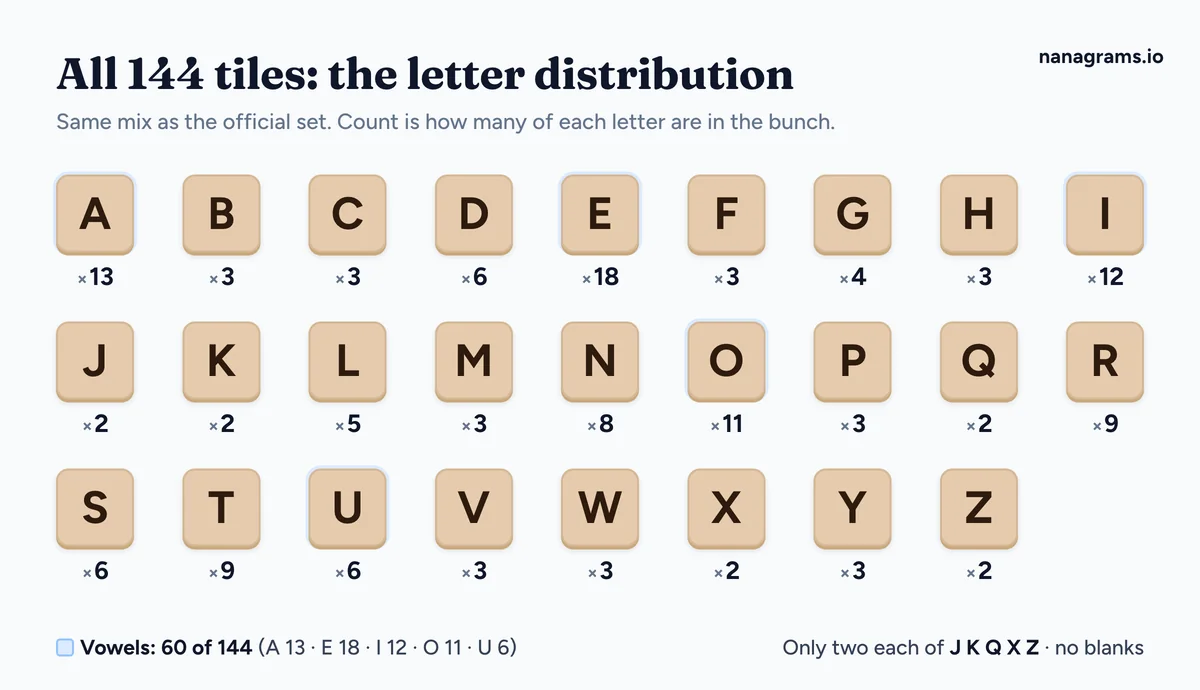
| Letter | Tiles | Letter | Tiles |
|---|---|---|---|
| A | 13 | N | 8 |
| B | 3 | O | 11 |
| C | 3 | P | 3 |
| D | 6 | Q | 2 |
| E | 18 | R | 9 |
| F | 3 | S | 6 |
| G | 4 | T | 9 |
| H | 3 | U | 6 |
| I | 12 | V | 3 |
| J | 2 | W | 3 |
| K | 2 | X | 2 |
| L | 5 | Y | 3 |
| M | 3 | Z | 2 |
If you know Scrabble, the differences matter: Scrabble uses 100 tiles, including two blanks, and scores letters by rarity. Bananagrams has 144, no blanks, and no points. Only speed matters, so the common letters (E, A, I, O, R, T, N) are what you build the skeleton of your grid from, and the rare ones are what you dump. Online, Nanagrams uses this same distribution, scaled when you pick a smaller or larger tile set.
Popular house rules and variations
The base game is solid, but most regular players tweak a thing or two. These are the common ones.
Minimum word length
The standard game allows two-letter words. Banning them (three-letter minimum) is the single most common house rule, because it cuts off the QI / ZA / XU escape hatch and forces longer words. Four-letter minimum is brutal and only worth trying with strong players.
Online, Nanagrams lets you set the minimum word length when you create a room.
Dump limits or no dumping
Some groups cap dumps (say, three per game) or ban them outright. No dumping makes a bad draw genuinely punishing and rewards players who can squeeze a Q or a J into a word. It is a real difficulty bump.
Smaller bunch for faster games
Short on time? Pull a fixed number of tiles out of the box before you start (say, half of them) and play with the rest. Fewer tiles means fewer peels and a quicker finish. This is not an official mode, just a handy way to fit a round into a coffee break.
Team Bananagrams
Pair up and build one shared grid per team. It turns a silent race into a conversation and is a good way to bring in a younger or newer player without leaving them stranded.
Official spin-off sets
Bananagrams also makes standalone variants worth knowing about: Double Bananagrams (288 tiles, 2-16 players — same rules, deeper bunch), and themed editions like the party and travel sets. They use the same core rules, just different tile counts or twists.
How online Bananagrams differs (Nanagrams)
The rules carry over unchanged. What changes is that you click instead of shout, and the computer handles the bookkeeping. Nanagrams is a free online version that maps the calls onto buttons. For a step-by-step walkthrough of a full online game, see how to play Bananagrams online:
| Physical Bananagrams | Online (Nanagrams) |
|---|---|
| Call "Split!" to start | Host clicks Start Game |
| Call "Peel!" when your hand is empty | Click the DRAW button (or press D) |
| Call "Dump!" to swap a tile | Select a tile, click SWAP |
| Call "Bananas!" to win | Click the GRAMS button |
| Slide physical tiles around | Click and drag tiles on screen |
| You cannot see opponents' grids | Live opponent tile counts |
| No undo, mistakes are permanent | Undo and redo (Cmd/Ctrl + Z) |
| You argue over the dictionary | Words are checked automatically |
The biggest practical difference is the automatic word check. Online, a rotten-banana win is impossible the way it happens at a table, because the game tells you the moment a word is invalid. You can also undo a move you regret, which changes how aggressively you experiment with your grid. For the full digital ruleset and the room settings (tile count, minimum word length, swap on or off), see the Nanagrams rules page.
Rules questions that come up at the table
What if two people call Bananas at almost the same time?
There is no official tiebreaker, so groups handle it their own way: check both grids and the first valid one wins, or count it as a shared win. Online the platform settles it with a server timestamp, so whoever clicked first by a fraction of a second takes it.
What dictionary should we use?
Pick one and agree before the first split. Most competitive players use a Scrabble word list (TWL in North America, SOWPODS internationally) because they are exhaustive and settle arguments fast. A regular household dictionary is fine for casual games. Online, Nanagrams uses a large built-in word list, so there is nothing to decide.
Can I count tiles left in the bunch?
No peeking or counting the face-down bunch. You judge the endgame by eye, watching the pile shrink. The moment it looks like fewer tiles than players, it is time to race for Bananas. Online removes the guesswork by showing the exact count.
What if the bunch empties and nobody has won?
Play simply continues with no more peeling, since there are not enough tiles to deal one to everyone. Everyone keeps building from the tiles in hand, and the first to use them all in a valid grid calls Bananas and wins.
Do I have to use a word I already started?
No. Nothing is committed until the game ends. You can break apart any word, any time, and reuse the letters elsewhere. That freedom is exactly why fast players keep their grids loose rather than locking in long words early.
Quick tips once you know the rules
- Learn the two-letter words. QI, ZA, XU, and AA save you constantly when you need to attach an awkward letter.
- Keep your grid loose. Long words look impressive but lock up letters you may need later.
- Peel the second your hand clears. Sitting on an empty hand only helps your opponents.
- Dump only when one tile is truly stuck. Three new tiles is a real cost.
- Do a quick read of your whole grid before you call Bananas. One typo turns a win into a rotten banana.
For a deeper breakdown, see our Bananagrams strategy tips.
What is Bananagrams? A little history
Bananagrams is a tile-based word game created in 2006 by Rhode Island grandfather Abe Nathanson and his family, who set out to build an anagram game fast enough to drive you bananas. It ships as 144 letter tiles in a zip-up banana pouch — no board, no scorepad, no turns. Every player simultaneously builds a private crossword grid from their own tiles, drawing more as they go, and the first to use every tile in a valid grid wins. It has sold millions of copies worldwide and spawned official variants like Double Bananagrams — and free online adaptations like Nanagrams, which run the same race in a browser.
Frequently Asked Questions
What are the official Bananagrams rules?
Everyone draws starting tiles from the bunch (21 each for 2 to 4 players), calls "Split!" to flip them all at once, and builds their own connected crossword. Empty your hand and call "Peel!" to make everyone draw one more tile. Call "Dump!" to swap a bad tile for three. When the bunch has fewer tiles than players, the first person to finish a valid grid calls "Bananas!" and wins if their grid checks out.
How many tiles do you start with in Bananagrams?
It depends on the group. 2 to 4 players draw 21 tiles each, 5 to 6 players draw 15 each, and 7 to 8 players draw 11 each. There are 144 tiles total, and whatever is not dealt stays in the bunch for peeling.
What is the Bananagrams letter distribution?
The 144 tiles break down as A 13, B 3, C 3, D 6, E 18, F 3, G 4, H 3, I 12, J 2, K 2, L 5, M 3, N 8, O 11, P 3, Q 2, R 9, S 6, T 9, U 6, V 3, W 3, X 2, Y 3, Z 2. There are no blank tiles. Vowels make up 60 of the 144.
How many players can play Bananagrams?
A standard set covers 1 to 8 players, from a solo puzzle up to a group of eight. For more than eight you need a second set or the official Double Bananagrams (288 tiles). Online, Nanagrams rooms hold up to 8.
How do you play Bananagrams alone?
Draw 21 tiles, flip them, and build your grid. Each time your hand is empty, peel one tile from the bunch and keep going until the bunch is empty and every tile sits in a valid, connected grid. Time yourself and try to beat it, or add a rule such as no dumping. Online you can also add a bot opponent to a solo game.
Can you use proper nouns in Bananagrams?
No. Proper nouns are out, which covers names of people, places, brands, days, and months. The one exception is a word that also exists as an ordinary lowercase word: MARCH (the verb), CHINA (dishware), or BILL (an invoice) are legal for those meanings, not as names.
Are abbreviations allowed in Bananagrams?
No. TV, USA, and ASAP do not count. The only abbreviations that work are the ones the dictionary now lists as full words in their own right, like RADAR and LASER.
Can you repeat words in Bananagrams?
Yes — repeating a word (using the same word twice) is allowed. Nothing stops you from repeating a word in your own grid, and with short connectors like AT and IT you almost always will. Different players can also use the same words, since each grid is separate.
How do you play Double Bananagrams?
Exactly like the regular game, with 288 tiles instead of 144 and support for 2 to 16 players. Starting draws use the same brackets (21 / 15 / 11 tiles). Full setup details are in our Double Bananagrams rules guide.
Can you rearrange your grid in Bananagrams?
Yes, anytime and with no penalty. You can break apart words and rebuild your whole grid to fit a new tile. Doing it constantly is normal play, not a workaround.
Is there a printable version of the Bananagrams rules?
Yes. Our free one-page PDF covers setup, starting tiles by player count, the four calls (Split, Peel, Dump, Bananas), allowed and banned words, a glossary, and quick tips. Download the printable rules and keep a copy in the banana pouch.
What is the difference between physical and online Bananagrams rules?
The rules are identical. The calls just become buttons. On Nanagrams, DRAW is the peel, SWAP is the dump, and GRAMS is the win. Online also validates words for you, shows live opponent tile counts, and lets you undo.
Try it online
The fastest way to learn these rules is to play a round. Nanagrams runs the same game in your browser, free, with the word checking handled for you so you can focus on building. If you want every setting spelled out first, the rules page covers tile counts, minimum word length, and swap options.
Play Bananagrams online, free
Automatic word checking, custom settings, and up to 8 players. No download, no signup.